
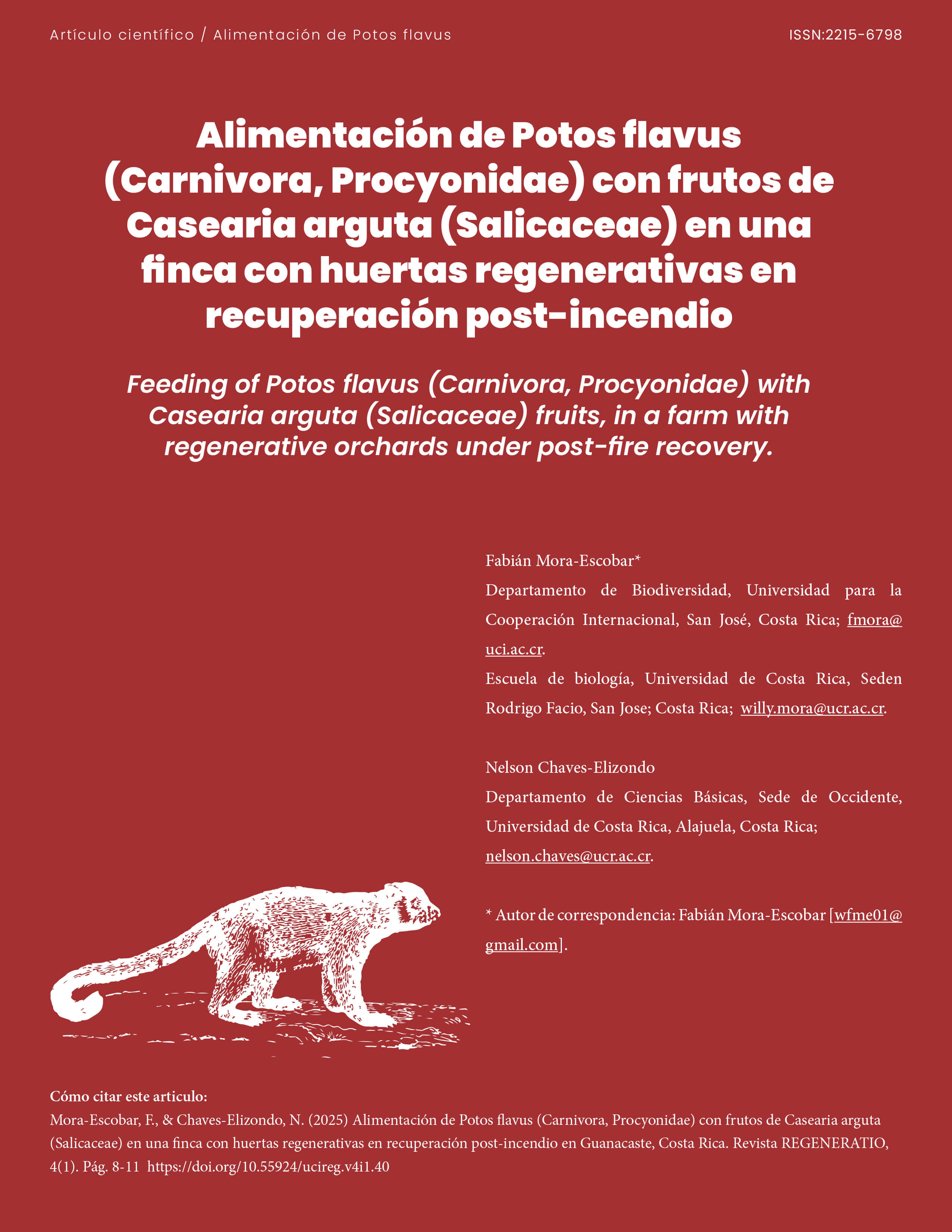
Feeding of Potos flavus (Carnivora, Procyonidae) on fruits of Casearia arguta (Salicaceae) in a farm with regenerative orchards in post-fire recovery.
DOI:
https://doi.org/10.55924/ucireg.v4i1.40Keywords:
Kinkajou, Seed dispersal, mesocarnivores, Cafecillo, PalomaríaAbstract
An individual Potos flavus, commonly known as kinkajou, was observed consuming Casearia arguta fruits on a farm in Nambí, Nicoya, Costa Rica, on March 25, 2022. This arboreal, nocturnal, and omnivorous mammal actively consumed 33 fruits over 90 minutes, a significant behavior given that the area had experienced a forest fire one month prior. This observation is noteworthy, as there had been no previous records of P. flavus feeding on C. arguta. The identification of both the animal and the tree was based on morphological characteristics and field observations. This event highlights the importance of P. flavus as a seed disperser, particularly in areas undergoing regeneration following disturbances. Additionally, it emphasizes this species' adaptability to habitat changes, which is crucial for the conservation of recovering tropical ecosystems.
References
Arcos Torres, A., & Solano Ugalde, A. (2006). Importance of a fructivorous carnivore Potus flavus (Procyonidae: Mammalia), in the germination of Cordia panamensis (Boraginaceae).
González, J. (2010). Flacourtiaceae. En B.E., Hammel, M.H. Grayum, C. Herrera, & N. Zamora, (eds.), Manual de Plantas de Costa Rica, vol. 5, (Clusiaceae-Gunneraceae) (pp. 395-775). St. Louis, Missouri, USA: Missouri Botanical Garden Press.
Julien-Laferrière, D. (1999). Foraging strategies and food partitioning in the neotropical frugivorous mammals Caluromys philander and Potos flavus.. Journal of Zoology, 247(1), 71-80.
Kays, R. W. (2000). The behavior and ecology of olingos (Bassaricyon gabbii) and their competition with kinkajous (Potos flavus) in central Panama.
Nakashima, Y., & Do Linh San, E. (2022). Seed dispersal by mesocarnivores: Importance and functional uniqueness in a changing world. Small carnivores: Evolution, ecology, behaviour, and conservation, 347-391.
Nascimento, F. F., Oliveira-Silva, M., Veron, G., Salazar-Bravo, J., Gonçalves, P. R., Langguth, A., ... & Bonvicino, C. R. (2017). The evolutionary history and genetic diversity of Kinkajous, Potos flavus (Carnivora, Procyonidae). Journal of Mammalian Evolution, 24, 439-451.
Pineda-Munoz, S., & Alroy, J. (2014). Dietary characterization of terrestrial mammals. Proceedings of the Royal Society B: Biological Sciences, 281(1789), 20141173.
Timm, R. M. (2011). Reid, FA (2009). A Field Guide to the Mammals of Central America & Southeast Mexico. Oxford University Press, New York, 346 pp.+ 52 color plates. ISBN-978-0-19-534322-6, price (hardbound), 149.00;ISBN-978-0-19-534323-6,price(paper), 45.00.
Valenta, K., & Fedigan, L. M. (2010). Spatial patterns of seed dispersal by white‐faced capuchins in Costa Rica: evaluating distant‐dependent seed mortality. Biotropica, 42(2), 223-228.
Villegas, S. (2022). Nuevos registros en la dieta de nueve especies de aves neotropicales de Costa Rica. Zeledonia, 26(2).
Additional Files
Published
How to Cite
Issue
Section
Categories
License
Copyright (c) 2025 Fabian Mora Escobar, Nelson Chaves-Elizondo

This work is licensed under a Creative Commons Attribution-NonCommercial-ShareAlike 4.0 International License.
Contributions to the journal are made under the terms of the Creative Commons Attribution-NonCommercial-NoDerivatives 4.0 International License (CC BY-NC-ND 4.0).
The use of this type of license grants a user permission to share — copy and redistribute the material in any medium or format, as long as:
- Proper attribution or recognition is given to the author(s) of the licensed material and any other person designated for attribution or recognition, in any reasonable manner requested by the Licensor.
- A link to the license is provided, and it is indicated if changes have been made. This can be done in any reasonable manner, but not in a way that suggests that you or your use are endorsed by the Licensor.
- The material is not used for commercial purposes.
- The original content of the material is not modified. If remixing, transforming, or creating from the material, the modified material cannot be distributed.